Quick Answer: Two weeks road tripping through Tasmania’s wild landscapes.
Tasmania completely surprised me.
I’d seen the photos before arriving — Cradle Mountain reflected in still water, the curve of Wineglass Bay from above, orange-lichened boulders along white sand. Beautiful images, but they’d given me the impression that Tasmania was a highlights reel. A few famous viewpoints stitched together by long drives through empty farmland.
I was wrong.
Within the first few days of driving around the island, I started understanding what makes Tasmania different from anywhere else I’ve travelled. It wasn’t just the landscapes — it was how quickly they changed. One morning I was walking through temperate rainforest so thick with ferns and moss that the air felt green. By afternoon I was standing on a windswept clifftop watching the Southern Ocean throw itself against dolerite columns. And that evening, I watched a wombat waddle out of the scrub at Ronny Creek and start grazing five metres from my feet like I wasn’t even there.
I spent two weeks road tripping around Tasmania, and by the time I returned my rental car, this island had quietly become one of my favourite places in the world.
This guide is everything I learned along the way — the planning decisions that matter, the things I’d do differently, and the experiences that made me want to come back.
Why Tasmania Feels Unlike Anywhere Else in Australia
I’ve travelled through parts of mainland Australia, but Tasmania operates on a completely different frequency.
It’s cooler, greener, smaller and much quieter. Over 40 percent of the island is protected as national park or World Heritage wilderness, which means enormous stretches of the landscape haven’t been touched. When I drove through the west coast towards Strahan, there were long stretches where I didn’t pass another car for twenty minutes — just dense forest pressing in from both sides of the road and clouds sitting low enough to touch.
The scale is what makes it work so beautifully for road trips. Tasmania is roughly the size of Ireland, so driving between destinations rarely takes more than a few hours. I’d wake up beside a misty highland lake, eat fresh oysters by the east coast for lunch and watch wallabies appear from the bush as the sun dropped. All in the same day, without feeling rushed.
That compact geography also means every region feels genuinely different. The east coast is sheltered, sunny and dotted with white beaches. The west coast is raw, wet and wild — shaped by mining history and relentless weather. The midlands feel pastoral and English. The central highlands feel almost alpine. And the cities — Hobart especially — have this creative, slightly eccentric energy that I wasn’t expecting at all.
Coming from Turkey, where I’m used to dramatic landscape shifts between regions, Tasmania felt surprisingly familiar in that way. The difference is that here, those shifts happen within an hour’s drive instead of eight.
When to Visit Tasmania
Before my trip, I spent too long trying to find the “right” month to visit. I eventually stopped overthinking it, booked outside peak summer and accepted whatever weather Tasmania decided to throw at me.
It threw everything.
During my two weeks, I had gorgeous sunshine along the east coast, sideways rain on the west coast, freezing wind at the summit of kunanyi in Hobart and actual snow flurries around Cradle Mountain. All in the same trip. Locals weren’t surprised — they just shrugged and said that’s normal.
Summer (December through February) gives you the warmest temperatures, the longest days and the best hiking conditions. It’s also when accommodation books out fastest and prices peak, particularly around Freycinet and Cradle Mountain.
But I actually think the shoulder seasons deserve more attention. Autumn (March to May) brings beautiful foliage, quieter trails and noticeably lower prices. Spring (September to November) delivers wildflowers, penguin breeding season and that same pricing benefit. You’ll deal with cooler temperatures and occasional rain, but if you dress properly, neither season limits what you can do.
Winter (June to August) is genuinely cold in the highlands, but Hobart’s Dark Mofo festival gives the season real character, and the moody winter light over places like Dove Lake is stunning in a way that summer can’t replicate.
My honest take: pack layers, carry waterproof gear everywhere and stop trying to outsmart the weather. Tasmania will do what it wants regardless. If you want the full month-by-month breakdown — including what activities work best in each season — I’ve covered it all in my guide on the best time to visit Tasmania.
How to Get to Tasmania
Tasmania is an island sitting across Bass Strait from mainland Australia, so you’re either flying or catching a ferry. There’s no road bridge, no train — just sea and air.
Flying is what most travellers do. I flew into Hobart, which receives direct domestic flights from Melbourne (about an hour), Sydney and Brisbane. Launceston also has an airport with regular mainland connections. Hobart puts you closer to the south coast, Bruny Island and the Tasman Peninsula. Launceston works better if you want to start in the north — Cradle Mountain and the Tamar Valley wine region are within easy driving distance.
The Spirit of Tasmania ferry is the other option. It crosses overnight from Geelong (near Melbourne) to Devonport on Tasmania’s north coast, taking around 11 hours. The big advantage is bringing your own vehicle, which saves on rental costs if you’re already driving in Australia. The experience itself feels like a proper arrival — waking up as the ship pulls into Devonport harbour with Tasmania’s coastline slowly appearing through the morning haze.
I chose to fly because it was faster and cheaper for my situation, but I know travellers who swear by the ferry crossing, especially families and campervan owners.
The decision really comes down to your itinerary and where you want to start. I’ve broken down the full comparison — costs, booking tips, pros and cons of each route — in my separate guide on how to get to Tasmania.
Getting Around Tasmania
Let me save you the research: you need a car.
I know that sounds limiting, and I normally prefer destinations with good public transport. But Tasmania’s best experiences — the national parks, the coastal lookouts, the farm-gate stalls selling cheese and honey on quiet country roads, the beaches you stumble across because a hand-painted sign pointed down a dirt track — none of them are reachable by bus.
I rented a car for my entire two-week trip, and it was the single best decision I made. A campervan is another solid option, especially for budget travellers, because it combines transport and accommodation in one cost.
What I wish someone had told me about driving here:
Most highways have only one lane in each direction. They’re generally well-maintained, but there’s no overtaking for long stretches, so if you get stuck behind a slow truck on a mountain pass, patience becomes a survival skill. Many routes to remote attractions turn into narrow, winding roads — sometimes gravel — where the GPS time estimate becomes a polite fiction.
I learned quickly to avoid packing too much driving into a single day. When I drove from Hobart to Strahan on the west coast — roughly four and a half hours direct — it felt long after a morning spent hiking. Tasmania rewards slow driving, not marathon sessions.
Fuel stations and shops disappear in remote areas. I started filling my tank and grabbing supplies whenever I passed through a larger town, and that small habit probably saved me twice.
The most important rule I followed: no driving after sunset. Wallabies, possums and other wildlife flood the roads after dark. A collision isn’t just dangerous for you — it’s usually fatal for the animal. I saw enough roadside evidence to take this seriously from day one.
Without a car, your options narrow but don’t vanish completely. Tassielink Transit buses connect major towns. Shuttle services run to Cradle Mountain and Freycinet during peak season. You could base yourself in Hobart and do day tours to Bruny Island, Port Arthur and Mount Field. But you’ll miss the spontaneous freedom — the unplanned detours and unexpected stops — that makes a Tasmania road trip so special.
Where to Stay in Tasmania
Accommodation in Tasmania ranges from luxury lodges with national park views to free campgrounds where you’re sharing the clearing with wombats.
I used a mix during my two weeks. Guesthouses and small hotels in the towns, camping in the national parks when the weather cooperated.
In Hobart, the waterfront area and Salamanca Place have the widest selection — everything from boutique hotels in converted warehouses to backpacker hostels. It’s the only place in Tasmania where you’ll feel genuinely spoiled for choice.
Along the east coast, particularly around Coles Bay (the gateway to Freycinet), accommodation is popular and books out fast in summer. I’d recommend securing your east coast stays at least two to three months ahead if you’re visiting between December and February. The same applies to Cradle Mountain — limited lodges and cabins mean late bookers end up staying in Sheffield or Devonport and driving in, which adds time.
On the west coast, Strahan is the main base. It’s a small harbour town without a huge range, but the guesthouses are comfortable and the waterfront setting is beautiful. Don’t expect Hobart-level options here — that’s part of the west coast’s character.
Camping is one of the best ways to experience Tasmania. National park campgrounds run around $13–16 AUD per person with basic facilities. Free and low-cost campsites on public land exist across the island — apps like WikiCamps list them with reviews and facility details. I met several travellers doing the whole trip by campervan, splitting nights between free spots and powered holiday parks ($25–40 AUD per night), and spending almost nothing on accommodation.
Booking tip: Outside summer, you’ll have much more flexibility and lower prices across the board. Autumn and spring pricing drops noticeably, and you won’t face the stress of sold-out properties.
Best Things to Do in Tasmania
Two weeks gave me enough time to experience Tasmania across its different moods — coast, mountains, forest, history, food. Rather than listing every attraction, I want to highlight the types of experiences that made this trip feel different from anywhere else I’ve travelled.
I’ve written a much more detailed guide covering the full list of things to do in Tasmania, but here’s what stood out most.
Hiking defined the trip. I did the Dove Lake Circuit at Cradle Mountain with weather that shifted from sunshine to rain in minutes. The Wineglass Bay and Hazards Beach Circuit in Freycinet took me around 12 kilometres through granite peaks and hidden coves. The Cape Hauy trail on the Tasman Peninsula was 10 kilometres return of dramatic sea cliffs — the steps were relentless but the views at the end were absurd. And the Fluted Cape Walk on Bruny Island ran above some of the tallest sea cliffs in the Southern Hemisphere, with sections close to exposed edges that required careful footing.
Each hike had a completely different character. That variety is what makes Tasmania’s trail network so addictive.
Wildlife showed up when I least expected it. Wombats grazing at Ronny Creek near Cradle Mountain during golden hour. Pademelons appearing along forest trails at Mount Field. An entire population of wombats roaming freely across Maria Island as if they’d never seen a fence. And the white Bennett’s wallabies near Alonnah on Bruny Island at dusk — a rare genetic variant that Bruny is one of the few places to see.
Food kept surprising me. Launceston holds a UNESCO City of Gastronomy title, and once I started exploring its food scene — the local wine, the farm-to-table cooking, the café culture — I understood why. Fresh oysters near Freycinet at Devil’s Corner alongside a glass of Tasmanian Pinot Noir became one of those simple travel moments I’ll remember for a long time. And I didn’t expect to be tasting local honey in the middle of a rainforest during a heritage railway journey on the west coast, but that’s Tasmania.
History ran deeper than I’d anticipated. Port Arthur on the Tasman Peninsula is one of Australia’s most significant convict heritage sites. I expected a single ruin — instead I found an entire historic village. I’d recommend collecting a map at the entrance because the site is large enough to get lost in. MONA in Hobart was the opposite experience — a contemporary art museum built underground, full of confronting, strange and deliberately uncomfortable exhibits. I took the ferry from Hobart’s waterfront to reach it, which made the whole visit feel like a pilgrimage to something you couldn’t quite prepare for.
Tasmania’s Must-Visit National Parks
Tasmania has 19 national parks, and a holiday parks pass ($80 AUD, valid for two months at the time of writing) pays for itself within two or three visits. I bought mine before my first park entrance and used it almost every day of the trip.
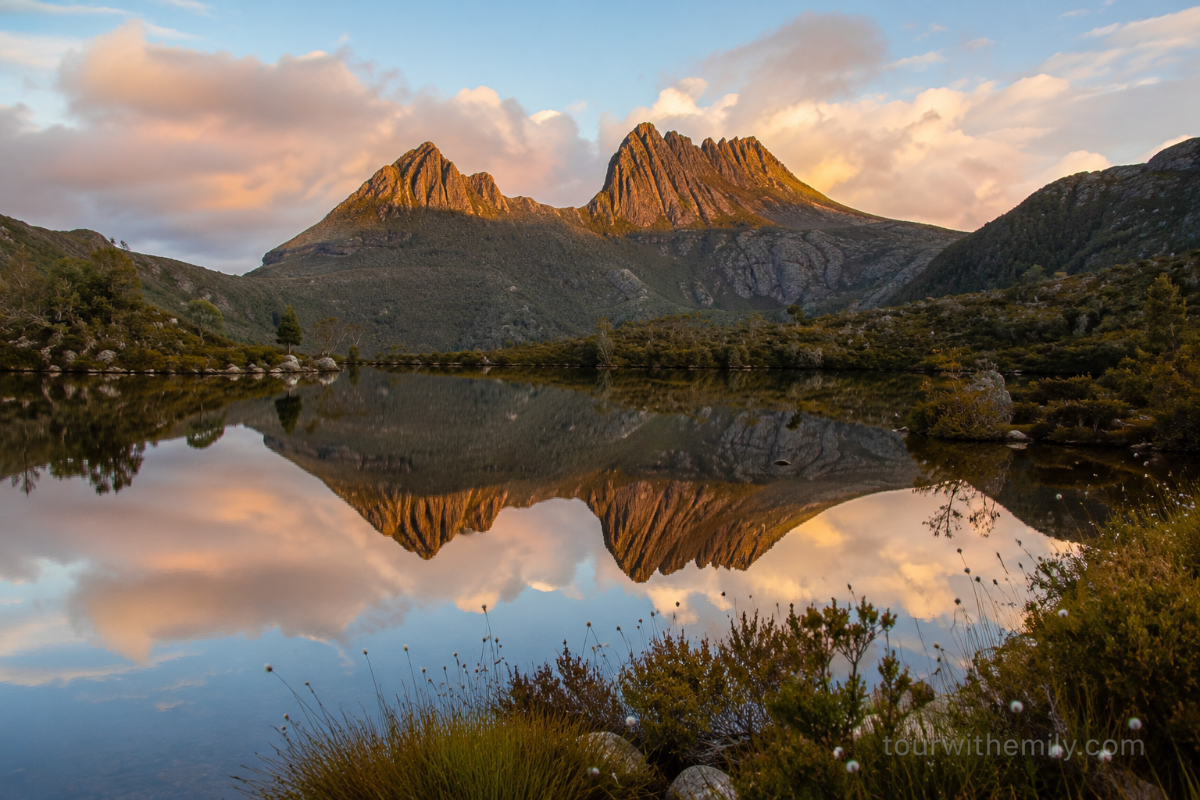
Cradle Mountain–Lake St Clair National Park left the strongest impression. Dove Lake sitting beneath the jagged outline of Cradle Mountain is the image most people associate with Tasmania, and walking the circuit around the lake — through woodland, along the water’s edge, with the mountain constantly shifting shape as the light changed — felt like earning that postcard view rather than just seeing it.
What I wasn’t prepared for was how aggressive the weather is up there. I went from needing sunglasses to needing my waterproof jacket within fifteen minutes. Layers aren’t optional at Cradle Mountain — they’re survival gear. I also walked towards Ronny Creek around golden hour and saw several wombats grazing nearby, completely unbothered by the handful of people watching from the boardwalk.
If you’re planning a visit and want to know exactly which trails to choose, what to pack and how to get there, I’ve written a complete Cradle Mountain hiking guide for beginners.
Freycinet National Park holds the view that sells Tasmania to the world. Climbing to the Wineglass Bay lookout and seeing that perfect crescent of white sand curving below turquoise water is one of those moments that actually lives up to its reputation.
But I’d recommend going beyond the lookout. The full Hazards Beach Circuit — roughly 12 kilometres — gave me a much richer experience of the park’s granite peaks, quiet bays and coastal forest. I’d planned to climb Mount Amos for the elevated view, but conditions were wet and the scrambling sections looked genuinely risky, so I made the call to skip it. Tasmania’s trails don’t have much tolerance for bad decisions in bad weather.
On a calmer day I spent time around Coles Bay, sampled local wine at Devil’s Corner and tried Tasmanian oysters for the first time. If the weather disrupts your hiking plans, the east coast food and wine scene provides an excellent backup. I’ve covered everything — trails, logistics, what to expect — in my Freycinet National Park visitor guide.
Mount Field National Park makes a perfect day trip from Hobart — it’s around 70 kilometres northwest of the city. Russell Falls is the centrepiece: a three-level waterfall surrounded by the kind of lush temperate rainforest that feels like stepping into another century. The path is short and easy, but I followed the longer Three Falls Circuit (approximately six kilometres), which connects three waterfalls through forests so thick with ferns and moss-covered trees that the light barely reaches the ground. I saw pademelons along the trail but the platypus that supposedly lives in the park’s streams stayed hidden.
Tasman National Park covers the dramatic coastline of the Tasman Peninsula. I hiked the Cape Hauy trail — 10 kilometres return — and the sea cliffs at the end are staggering. Towering dolerite columns dropping straight into the ocean, with the kind of views that make you instinctively step back from the edge. The trail has a lot of steps, so decent shoes and enough water matter more than fitness.
Maria Island is a national park you reach by ferry from Triabunna on the east coast. No cars allowed — you walk or cycle. The crossing can get rough when it’s windy, which I discovered firsthand. Once there, I walked to the Painted Cliffs (sandstone carved into colourful wave patterns by the tide) and the Fossil Cliffs (ancient marine fossils visible in exposed limestone). The loop took about two and a half hours. But the wildlife was the real point — wombats everywhere, wallabies on the paths, and an atmosphere so quiet it felt like the island belonged to the animals, not the visitors.
Wildlife in Tasmania: What You’ll Actually See
I’ve travelled through a lot of places that promise amazing wildlife and deliver a distant silhouette through binoculars. Tasmania is not one of those places.
The wildlife here is close, calm and shockingly casual about being watched.
Wombats were the animal I saw most. On Maria Island they were everywhere — grazing on grass, waddling across paths, completely indifferent to the group of humans photographing them from three metres away. At Ronny Creek near Cradle Mountain, they emerged during golden hour in exactly the spot the ranger said they would. Seeing a wombat in its natural habitat for the first time is one of those simple, genuine moments that no photo fully captures.
Tasmanian devils are the species everyone asks about, but they’re nocturnal and hard to find in the wild. I joined the after-dark feeding experience at Devils@Cradle, a conservation sanctuary near Cradle Mountain. The tour runs at night — you stand in a dimly lit enclosure and watch devils tear into food with their jaws, growling and snapping at each other with an intensity that’s both alarming and fascinating. The guides explained the conservation work behind their survival, including the battle against devil facial tumour disease. These tours fill quickly, so booking ahead is essential.
Wallabies and pademelons appeared almost daily — along forest trails, in campground clearings, beside the road at dusk. On Bruny Island, I specifically went looking for the rare white Bennett’s wallabies near the small town of Alonnah. They’re caused by a genetic trait unique to Bruny’s population, and as the light faded, several appeared at the edge of the scrubland. Finding them felt like earning a quiet reward for staying out past sunset.
Penguins breed along Tasmania’s coast. Bicheno on the east coast runs nightly guided tours during breeding season where visitors watch little penguins waddle ashore to their nests.
Platypus are the ones that got away. They live in Tasmania’s freshwater streams — Mount Field and Cradle Mountain are known spots — but they’re shy and most active at dawn and dusk in still water. I tried twice and saw nothing. Tasmania always leaves you a reason to come back.
For specific locations, best times of day and seasonal tips for each species, I’ve put together a dedicated Tasmania wildlife guide.
Tasmania Road Trip Planning
A road trip isn’t just the best way to see Tasmania — it’s the way the island is designed to be experienced.
The classic route follows a rough loop around the island. Most travellers start in Hobart (if flying) or Devonport (if arriving by ferry) and work their way around, connecting the east coast, the north, the highlands and sometimes the west coast before circling back.
Seven days covers the major highlights — Hobart, Freycinet, Bay of Fires, Launceston, Cradle Mountain and either the Tasman Peninsula or Bruny Island. It works, but you’ll be moving every day with limited time at each stop.
Ten to fourteen days is where the trip really opens up. I spent two weeks and still felt like I could have stayed longer. That extra time let me add the west coast (Strahan and the Wilderness Railway), Maria Island, Mount Field and Bruny Island without any single day feeling rushed. It also meant I could lose a day to rain without stressing about falling behind.
The Bay of Fires deserves a mention here because it anchored the most visually striking day of my entire trip. The stretch around Binalong Bay and The Gardens — white sand, clear turquoise water, enormous granite boulders covered in that bright orange lichen — was unlike anything I’d seen. The name actually comes from fires spotted along the coast by a British navigator in 1773, not from the colour of the rocks, which every second traveller (including me) assumes at first.
Which direction to drive isn’t a big decision, but heading east from Hobart along the coast towards Freycinet and Bay of Fires, then cutting across to Launceston before dropping south through Cradle Mountain is a popular and logical loop.
I’ve mapped out a full day-by-day route — including where to stop, how long to spend at each place and what to prioritise — in my Tasmania road trip itinerary.
Eating and Drinking Your Way Through Tasmania
I expected Tasmania’s food to be good. I didn’t expect it to rival the best food experiences I’ve had anywhere.
The island punches absurdly above its weight for a place with half a million people. The combination of clean soil, cool climate, fresh water and producers who genuinely care about what they grow creates ingredients that restaurants on the mainland would struggle to match.
Launceston set the tone early. The city holds a UNESCO City of Gastronomy title, and after spending a day moving between its restaurants, cafés and the surrounding wine region, the title felt deserved. I walked through Cataract Gorge in the morning — a beautiful natural reserve with trails, cliffs and a river running through it, somehow just minutes from the city centre — then spent the afternoon eating and drinking my way through local spots. That contrast between wilderness and food culture felt like the most Tasmanian thing possible.
Along the east coast, fresh oysters became a ritual. Near Freycinet, I stopped at Devil’s Corner for oysters and a glass of Tasmanian Pinot Noir and sat looking out at the Hazards while eating. It was one of those uncomplicated travel moments — nothing dramatic, just genuinely good food in a beautiful place — that I keep thinking about.
The Tamar Valley north of Launceston and the Coal River Valley near Hobart produce some of Australia’s best cool-climate wines — particularly Pinot Noir, Chardonnay and Riesling. Tasmania’s whisky scene is growing fast too, with distilleries scattered across the island now producing internationally awarded single malts.
Even on the west coast, where the vibe is rawer and simpler, food surprised me. During my West Coast Wilderness Railway journey, the train stopped at Lower Landing in the middle of the rainforest for a short walk and local honey tasting. Standing in a clearing surrounded by ancient trees, tasting honey made from the leatherwood flowers that grow only in Tasmania’s western wilderness — that’s not an experience you plan for. It just happens.
Bakeries across the island sell scallop pies — plump Tasmanian scallops in a rich sauce inside flaky pastry — and I ate more of them than I’d like to admit.
Tasmania on a Budget
Tasmania isn’t the cheapest destination in Australia, but I watched travellers do it on surprisingly tight budgets by making a few smart decisions.
Daily budget estimate: A budget traveller cooking most meals, using campgrounds and driving a rented car can manage on roughly $80–120 AUD per day (excluding car rental). Mid-range travellers staying in guesthouses and eating out once a day should expect $150–250 AUD.
Accommodation is where you save the most. Free and low-cost campsites on public land exist across the island — WikiCamps Australia is the app everyone uses to find them with reviews and facilities info. National park campgrounds cost around $13–16 AUD per person with basic facilities. Holiday parks with powered sites and hot showers run $25–40 AUD. A campervan paired with a mix of free camping and holiday parks is one of the cheapest ways to travel Tasmania.
Food costs drop fast when you cook. Stock up in larger towns — Hobart, Launceston, Devonport, Burnie — where supermarket prices are normal. Between towns, farm-gate stalls along the driving routes sell local cheese, berries, honey and bread at reasonable prices. These unplanned roadside stops were some of my favourite food moments of the trip.
Most of Tasmania’s best experiences are free (or nearly). A parks pass ($80 AUD) covers all 19 national parks for two months. Hiking to Wineglass Bay, walking the Dove Lake Circuit, watching wombats at Ronny Creek, swimming at Bay of Fires, exploring the Painted Cliffs on Maria Island — the activities that made my trip unforgettable cost nothing beyond that pass.
Car rental is the biggest expense after flights. Booking well in advance and comparing prices between Hobart and Launceston airports can save a meaningful amount — Launceston is sometimes cheaper. Avoid one-way drop-off fees by picking up and returning at the same airport.
Practical Tips for Visiting Tasmania
These are the things I either learned the hard way or wish someone had mentioned before I arrived.
Pack for four seasons in one day. Not an exaggeration. I experienced sunshine, rain, wind and snow within the same week. A waterproof jacket, warm base layers and comfortable walking shoes are non-negotiable regardless of what month you visit. Even when Hobart felt pleasantly mild, the summit of kunanyi (Mount Wellington) was dramatically colder — I climbed up in a light jacket and regretted it within minutes.
Phone signal disappears fast. Coverage is reliable in cities and larger towns but drops off quickly in national parks and along remote stretches of road. Download offline maps before leaving town. If you’re hiking, tell someone your route and expected return time — in most parks, you won’t be able to call for help if something goes wrong.
Carry cash for small towns. Most places accept cards, but a few farm-gate stalls, small cafés and campground honesty boxes work on cash only.
Buy travel insurance before you go. Tasmania’s wilderness is real wilderness. Hiking injuries, weather-related plan changes and rental car damage on gravel roads are common enough to justify proper coverage.
Tipping isn’t expected. Australia doesn’t have a tipping culture. Leaving a few dollars for exceptional service is appreciated but never required.
Left-hand driving. If you’re coming from a country that drives on the right — like Turkey — take extra care at roundabouts and when turning onto empty roads. Tasmania’s narrow, winding roads don’t leave much margin for error. I adjusted within a day, but the first few roundabouts required conscious concentration.
Solo Travel in Tasmania
I travelled Tasmania solo for two weeks and felt safe every single day.
The island is sparsely populated and the people I met — locals and travellers — were consistently friendly, relaxed and generous with tips. In hostels in Hobart and Launceston, I found other solo travellers easily. On hiking trails and at campgrounds, there’s a natural tendency for people travelling alone to gravitate towards each other, share a meal or swap route recommendations.
Safety wasn’t the challenge — logistics were. Having my own car meant total freedom, but it also meant every hour of driving was on me. My longest single day behind the wheel was around four and a half hours (Hobart to Strahan on the west coast), which was manageable but tiring after a morning of hiking. I learned to keep driving days under three hours when possible and save the longer stretches for days without early-morning activities.
For remote or longer hikes, I always let someone know my plan and expected return. Phone signal drops out in most national parks, and Tasmania’s trails — as beautiful as they are — can become genuinely isolated once you’re an hour from the trailhead.
As a solo female traveller, I didn’t encounter a single situation that felt uncomfortable. Tasmania’s pace of life and the kind of people it attracts — outdoorsy, curious, unhurried — create an environment where solo travel feels like the natural way to experience the island rather than something you need to justify.